

Train Early
Build your young birds' strength and stamina with safe, progressive elevation.
🏅 Early Athlete Training for Olympics (1-3 Months old)
An athlete who begins early gains powerful advantages:
Muscle memory & coordination – movements become natural and precise
Stronger bones and joints – built gradually to avoid injury
Discipline & timing – they learn when to attack, when to rest
Explosive power – jumping, turning, fast takeoff
Injury prevention – training matches their stage, never rushed
👉 The key principle: progressive elevation — you don’t push too high too early.
🐥 Applying the Same Principle to 1–3 Month Birds (Free-Range Wing Stamina System)
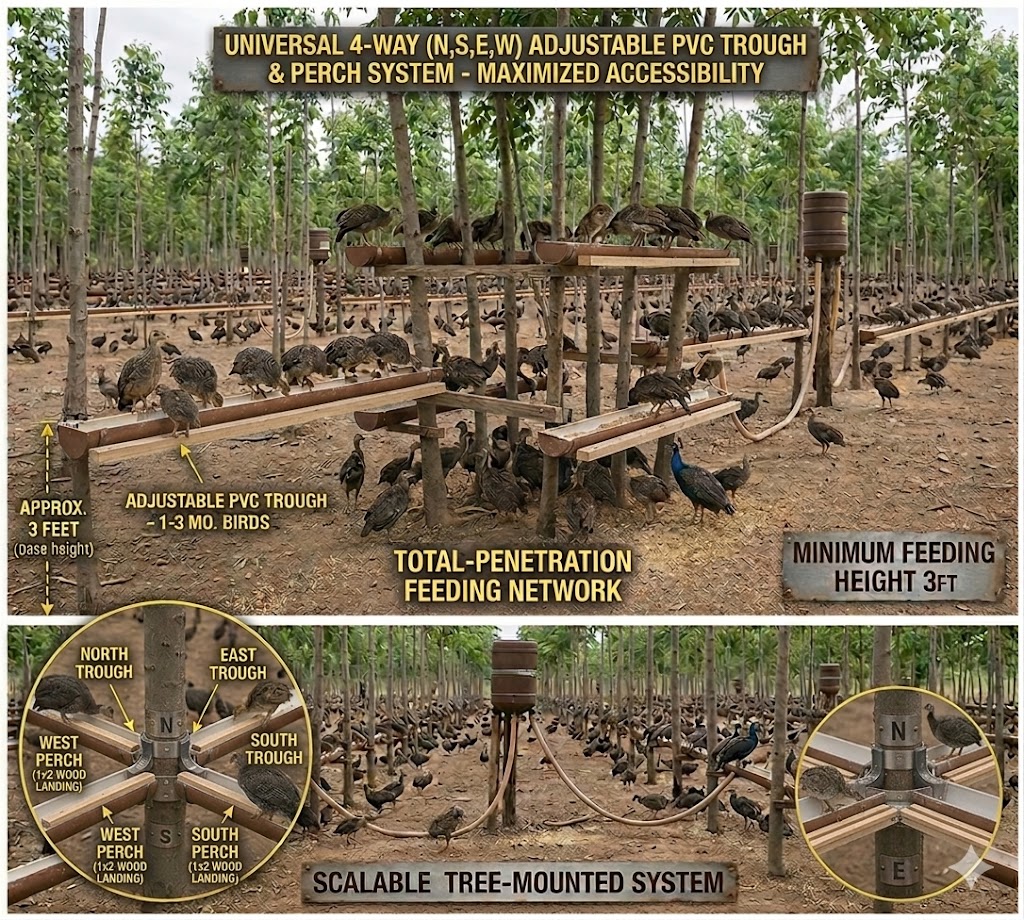
Your tree-mounted PVC trough + perch system is like a training gym for young athletes.
At 1 to 3 months old, birds enter a critical stage—this is where wing strength, balance, and stamina are built naturally.
✅ Why Elevation + Free-Range Setup Works (1–3 Months Birds)
At this age, birds are no longer weak chicks—they are junior athletes in development.
Your system (with perches and 4-way access) gives structured exercise:
1. Wing Stamina Development (Like Cardio Training)
Birds hop, flap, and glide from ground to perch
Repeated short flights build lung capacity and endurance
Strengthens wing muscles for sustained lift
2. Natural Launch Training (Explosive Power)
Perch height encourages controlled takeoff
Birds learn quick upward launch + fast recovery
Mimics real “combat-style” reflex movement
3. Balance & Coordination (Footwork Training)
Narrow wood perches train grip and stability
Improves landing accuracy and body control
Reduces clumsiness during flight and turns
4. 360° Accessibility (Situational Awareness)
Your N–S–E–W PVC trough design trains birds to:
Approach from different angles
Adjust body position quickly
Develop awareness and reaction timing
5. Free-Range Movement (Full-Body Conditioning)
Birds walk, run, and choose when to fly
Builds leg strength + wing coordination together
Encourages self-paced exercise (no stress training)
⚠️ Proper Height Progression (Very Important)
Just like athletes:
👉 Too low = no challenge
👉 Too high = injury
For 1–3 months birds, follow this safe progression:
1 Month: ~6 inches (low perch / feeder height)
2 Months: 1 to 2 feet
3 Months: up to 3 feet MAX (as shown in your design)
❌ Avoid going beyond this too early:
Prevents hard falls and wing strain
Ensures weaker birds can still access feed
Maintains confidence, not fear
🔧 Why Your Tree-Mounted System is Powerful
Uses natural environment (trees) = encourages real flight behavior
Adjustable PVC = matches growth stage
Perch + feeding combined = eat + exercise cycle
Scalable = supports many birds without crowding
🧠 Simple Analogy
Olympic athlete drills → build strength step-by-step
Your birds’ system → builds flight, stamina, and reflex naturally
👉 You are not just feeding birds…
👉 You are training airborne athletes.
🔥 Final Insight
From 1 to 3 months, this is the foundation stage.
If you manage:
correct height
free-range movement
perch-based feeding
👉 You develop birds with:
strong wings
fast launch ability
excellent balance and timing
Exactly like an athlete prepared for competition—trained early, trained right.
Train Early
Build strong wings and stamina with safe, progressive elevation.
Wing Stamina


Short flights build lung capacity and strengthen wing muscles.


Explosive Power
Perch height trains quick takeoff and fast recovery skills.
Narrow perches improve grip, balance, and landing precision.
Balance
FAQs
Why start early?
Early training builds muscle memory and coordination naturally.
How high perches?
Start at 6 inches for 1 month, then 1-2 feet at 2 months, max 3 feet at 3 months.
Why free-range setup?
Free-range encourages natural movement, builds stamina, balance, and reflexes without stress.
Avoid too high too soon to prevent injury and fear.
What if perch is too high?
How to progress height?
Increase perch height gradually to match bird’s growth and ability.


Flight
Building strength and balance with every flap and hop


My young birds gained strength and confidence thanks to the perch system.
Joan K.


The gradual height progression really helped prevent injuries during training.
Mark L.


★★★★★
★★★★★
Services
We offer high-quality poultry breeding focused on strong genetics, healthy stock, and consistent bloodlines. Our services include selective breeding, breeding stock sales, chick production through controlled hatching, and bloodline development. We also provide farm consultations, nutrition and health management, and custom breeding programs tailored to customer needs.
CONTACT:
Rentals
09184291989
© 2026. All rights reserved.
Angelo Rosaroso Vale, Jr.